Master in Pedagogy
CES Resolution: RPC-SO-33-No.5 82-2019
Resolución de los ajustes curriculares sustantivos: RPC-SO-13-No.233-2026
Acuerdo de los ajustes curriculares no sustantivos: ACU-CPP-SE-03-No.19-2026
Mode of Study
Online
Entry Profile:
To enrol in the Master’s Degree in Pedagogy, applicants should preferably hold an undergraduate degree in Educational Sciences or a Bachelor’s degree in the various branches of Pedagogy. Applicants with professional experience in related fields such as Psychology, Social Work, Family Guidance, and Educational Psychology will also be considered. Applicants with other qualifications must provide evidence of experience in the educational field (at least one year), as well as involvement in outreach and research projects related to education.
Graduate Profile:
What learning outcomes related to epistemological frameworks, cognitive capacities, and research competencies are required for future professional practice?
- Analysis of methods, strategies, and procedures for knowledge construction.
- Application of pedagogical knowledge to achieve educational quality required for comprehensive student development, fostering critical thinking, creativity, flexibility, cognitive independence, logical reasoning, critical reading, and reflection.
- Design of strategies, methods, methodologies, and programmes to facilitate the proper management and application of procedures for developing multi-, inter-, and transdisciplinary knowledge.
- Use of advanced educational technologies to integrate theory and practice in the classroom.
- Implementation of socio-educational projects within the community for the development of community social pedagogy.
- Application of managerial skills to coordinate pedagogical processes at both group and individual levels.
- Analysis of epistemological, conceptual, methodological, and procedural aspects for the development of pedagogy in the Ecuadorian context.
What learning outcomes related to professional and research methods, methodologies, models, protocols, processes, and procedures will be ensured in the programme?
- Management of scientific research methods related to Critical, Social, and Systemic Pedagogy for Integral Human Development.
- Development of didactic and pedagogical materials supported by scientific evidence using tools such as Microsoft Word and Excel for information systematisation.
- Promotion of student potential through comprehensive pedagogical methodologies adapted to educational diversity.
- Application of innovative techniques in the design and execution of educational projects.
- Skills and competencies for pedagogical intervention.
How does the future professional contribute to improving quality of life, the environment, productive development, and the preservation and enrichment of cultures and knowledge?
- Through integrating pedagogy, comprehensive student support, educational quality, meaningful learning, and development within knowledge-generation contexts.
- Attention to student behaviour: appropriate eye contact, body language awareness, and verbal communication.
- Sequential active listening skills: use of open and closed questions, paraphrasing, summarising, and emotional reflection.
- Integrative skills: application and monitoring of pedagogical theories during student interaction.
- Effective communication with professionals from other disciplines and social actors to promote research and educational innovation.
What values and principles will be promoted in professional training?
- Development of professional knowledge with ethical and humanistic responsibility.
- Self-awareness in emotional and cognitive responses when working with students.
- Identification of personal values and biases.
- Clarification of motivations and personal reactions.
- Ethical reflection in pedagogical practice.
- Responsible behaviour in teaching practice.
- Recognition of personal boundaries and autonomy.
- Application of cooperative and collaborative learning approaches with professional ethics.
General Objective
To train teachers to enhance the development of their pedagogical competencies in order to facilitate the active integration of students through an educational intervention that promotes the quality of the teaching–learning process and their comprehensive development. This is achieved through attention to diversity, improvement of academic performance, the development of social skills and participatory attitudes grounded in the values of coexistence, non-violence, and education for peace. In this way, students’ problems and concerns can be addressed, and their emotions managed through pedagogical work supported by neuropedagogy, which develops educational and didactic strategies for the scientific approach to learning and behavioural issues in the classroom.
Specific Objectives
- Knowledge and expertise: To promote the development of research competencies in order to deepen understanding of the essential principles of Pedagogy for students’ comprehensive development, as well as the design of pedagogical proposals for the prevention and educational management of school violence and education for peace.
- Relevance: To foster the development of educational projects aimed at supporting students with low academic performance and preventing this issue, as well as generating educational experiences that contribute to strengthening emotional intelligence and conflict mediation skills, promoting prevention and human development through group work and collaborative learning approaches.
- Learning processes: To adopt pedagogical culture as a strategic process within educational systems that enhances personal development, updates participants’ potential, and engages their resources in learning through the design and implementation of educational experiences that promote diversity and educational inclusion, based on values such as solidarity, dialogue, respect, equity, honesty, and social justice.
- Interculturality: To recognise Pedagogy and pedagogical culture as strategic processes within educational systems that enhance personal development, promote and update participants’ potential, and engage their resources in learning through the design and implementation of educational experiences that strengthen diversity and inclusion in regular contexts. Additionally, to promote and strengthen the development of research groups and networks in the fields of Pedagogy and Didactics through academic exchange and collaboration among teachers and participants in higher education institutions, integrating and systematising new learning and research models in line with the objectives of the Master’s Programme and the National Development Plan 2017–2021, “Toda una Vida”.
Class Schedule:
Saturday and Sunday
08:00 - 12:00
13:00 - 17:00
Modules:
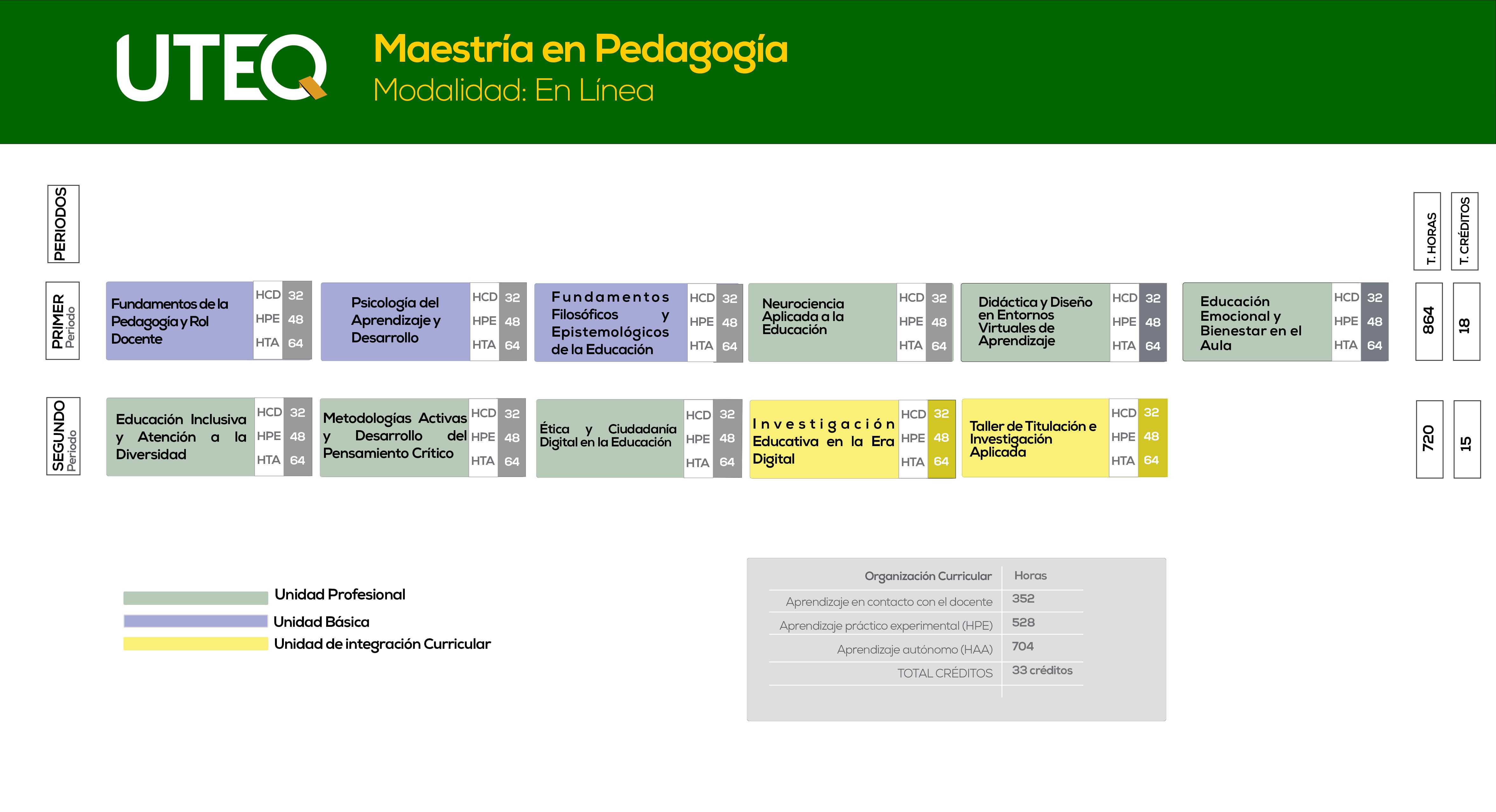
First Level
- Foundations of Pedagogy and Teaching Role
- Psychology of Learning and Development
- Philosophical and Epistemological Foundations of Education
- Neuroscience Applied to Education
- Didactics and Design of Virtual Learning Environments
- Emotional Education and Wellbeing in the Classroom
Second Level
- Inclusive Education and Attention to Diversity
- Active Methodologies and Development of Critical Thinking
- Ethics and Digital Citizenship in Education
- Educational Research in the Digital Era
- Degree Project and Applied Research Workshop
Entry Requirements:
- Application for admission to the master’s programme.
- Colour copy of national identity card and updated voting certificate.
- Colour copy of the university degree awarded by a Higher Education institution.
- SENESCYT registration.
- Certified copy of the graduation certificate with the corresponding grades obtained.
- Academic transcript of undergraduate studies.
ALL REQUIREMENTS MUST BE SUBMITTED IN DIGITAL FORMAT
Payment Methods:
- Bank transfer
- Bank deposit
- Credit card
- UTEQ agreement
Academic degree to be obtained:
Duration
12 months
Download
Request for information

Postgraduate